http://www.charlotte.com/409/story/617920.html
WALTER WILLIAMS
Now that another Earth Day has come and gone, let's look at some environmentalist predictions that they would prefer we forget.
At the first Earth Day celebration, in 1969, environmentalist Nigel Calder warned, "The threat of a new ice age must now stand alongside nuclear war as a likely source of wholesale death and misery for mankind." C.C. Wallen of the World Meteorological Organization said, "The cooling since 1940 has been large enough and consistent enough that it will not soon be reversed."
In 1968, Paul Ehrlich, Vice President Gore's hero and mentor, predicted there would be a major food shortage in the U.S. and "in the 1970s ... hundreds of millions of people are going to starve to death." Ehrlich said 65 million Americans would die of starvation between 1980 and 1989, and by 1999 the U.S. population would have declined to 22.6 million. Ehrlich's predictions about England were gloomier: "If I were a gambler, I would take even money that England will not exist in the year 2000."
World `likely to be ruined' by 2000
In 1972, a report was written for the Club of Rome warning the world would run out of gold by 1981, mercury and silver by 1985, tin by 1987 and petroleum, copper, lead and natural gas by 1992. Gordon Taylor, in his 1970 work "The Doomsday Book," said Americans were using 50 percent of the world's resources and "by 2000 they [Americans] will, if permitted, be using all of them." In 1975, the Environmental Fund took out full-page ads warning, "The World as we know it will likely be ruined by the year 2000."Harvard University biologist George Wald in 1970 warned, "... civilization will end within 15 or 30 years unless immediate action is taken against problems facing mankind." That was the same year that Sen. Gaylord Nelson warned, in Look Magazine, that by 1995 "... somewhere between 75 and 85 percent of all the species of living animals will be extinct."
It's not just latter-day doomsayers who have been wrong; doomsayers have always been wrong. In 1885, the U.S. Geological Survey announced there was "little or no chance" of oil being discovered in California, and a few years later they said the same about Kansas and Texas. In 1939, the U.S. Department of the Interior said American oil supplies would last only another 13 years. In 1949, the Secretary of the Interior said the end of U.S. oil supplies was in sight. Having learned nothing from its earlier erroneous claims, in 1974 the U.S. Geological Survey advised us that the U.S. had only a 10-year supply of natural gas. According to the American Gas Association, there's a 1,000 to 2,500 year supply.
Here are my questions: In 1970, when environmentalists were making predictions of manmade global cooling and the threat of an ice age and millions of Americans starving to death, what kind of government policy should we have undertaken to prevent such a calamity?
When Ehrlich predicted that England would not exist in the year 2000, what steps should the British Parliament have taken in 1970 to prevent such a dire outcome?
In 1939, when the U.S. Department of the Interior warned that we only had oil supplies for another 13 years, what actions should President Roosevelt have taken?
Why believe them this time?
Finally, what makes us think that environmental alarmism is any more correct now that they have switched their tune to manmade global warming?
A few facts: Over 95 percent of the greenhouse effect is the result of water vapor in Earth's atmosphere. Without the greenhouse effect, Earth's average temperature would be zero degrees Fahrenheit. Most climate change is a result of the orbital eccentricities of Earth and variations in the sun's output. And natural wetlands produce more greenhouse gas annually than all human sources combined.
Walter
Williams
--------------------------------------------------------------------------------
Walter E. Williams is a professor of economics at George Mason University. Write him c/o Creators Syndicate, 5777 West Century Blvd., Suite 700, Los Angeles, CA 90045.
Wednesday, May 14, 2008

Monday, May 5, 2008
Hiroshima Photo's


Photos of Hiroshima from the Robert L. Capp Collection
The Robert L. Capp collection at the Hoover Institution Archives contains ten never-before-published photographs illustrating the immediate aftermath of the Hiroshima bombing. These photographs, taken by an unknown Japanese photographer, were found in 1945 among rolls of undeveloped film in a cave outside Hiroshima by U.S. serviceman Robert L. Capp, who was attached to the occupation forces. Unlike most photos of the Hiroshima bombing, these dramatically convey the human as well as material destruction unleashed by the atomic bomb. Mr. Capp donated them to the Hoover Archives in 1998 with the provision that they not be reproduced until 2008. Three of these photographs are reproduced in Atomic Tragedy with the permission of the Capp family. Now that the restriction is no longer in force, the entire set is available below. Please contact Sean L. Malloy (mailto:smalloy@ucmerced.edu if you have any information that might help identify the original photographer.
The Robert L. Capp collection at the Hoover Institution Archives contains ten never-before-published photographs illustrating the immediate aftermath of the Hiroshima bombing. These photographs, taken by an unknown Japanese photographer, were found in 1945 among rolls of undeveloped film in a cave outside Hiroshima by U.S. serviceman Robert L. Capp, who was attached to the occupation forces. Unlike most photos of the Hiroshima bombing, these dramatically convey the human as well as material destruction unleashed by the atomic bomb. Mr. Capp donated them to the Hoover Archives in 1998 with the provision that they not be reproduced until 2008. Three of these photographs are reproduced in Atomic Tragedy with the permission of the Capp family. Now that the restriction is no longer in force, the entire set is available below. Please contact Sean L. Malloy (mailto:smalloy@ucmerced.edu if you have any information that might help identify the original photographer.
http://faculty.ucmerced.edu/smalloy/atomic_tragedy/photos.html
Thursday, May 1, 2008
This is the war that started with lies, and continues with lie after lie after lie

http://www.independent.co.uk/opinion/commentators/patrick-cockburn-this-is-the-war-that-started-with-lies-and-continues-with-lie-after-lie-after-lie-797788.html
RAMZI HAIDAR/AFP/Getty Images
A US Marine drapes a flag over the face of Saddam Hussein's statue in Baghdad on 9 April 2003
Wednesday, 19 March 2008
It has been a war of lies from the start. All governments lie in wartime but American and British propaganda in Iraq over the past five years has been more untruthful than in any conflict since the First World War.
The outcome has been an official picture of Iraq akin to fantasy and an inability to learn from mistakes because of a refusal to admit that any occurred. Yet the war began with just such a mistake. Five years ago, on the evening of 19 March 2003, President George Bush appeared on American television to say that military action had started against Iraq.
This was a veiled reference to an attempt to kill Saddam Hussein by dropping four 2,000lb bombs and firing 40 cruise missiles at a place called al-Dura farm in south Baghdad, where the Iraqi leader was supposedly hiding in a bunker. There was no bunker. The only casualties were one civilian killed and 14 wounded, including nine women and a child.
On 7 April, the US Ai r Force dropped four more massive bombs on a house where Saddam was said to have been sighted in Baghdad. "I think we did get Saddam Hussein," said the US Vice President, Dick Cheney. "He was seen being dug out of the rubble and wasn't able to breathe."
Saddam was unharmed, probably because he had never been there, but 18 Iraqi civilians were dead. One US military leader defended the attacks, claiming they showed "US resolve and capabilities".
Mr Cheney was back in Baghdad this week, five years later almost to the day, to announce that there has been "phenomenal" improvements in Iraqi security. Within hours, a woman suicide bomber blew herself up in the Shia holy city of Kerbala, killing at least 40 and wounding 50 people. Often it is difficult to know where the self-deception ends and the deliberate mendacity begins.
The most notorious lie of all was that Iraq possessed weapons of mass destruction. But critics of the war may have focused too much on WMD and not enough on later distortions.
The event which has done most to shape the present Iraqi political landscape was the savage civil war between Sunni and Shia in Baghdad and central Iraq in 2006-07 when 3,000 civilians a month were being butchered and which was won by the Shia.
The White House and Downing Street blithely denied a civil war was happening – and forced Iraq politicians who said so to recant – to pretend the crisis was less serious than it was.
More often, the lies have been small, designed to make a propaganda point for a day even if they are exposed as untrue a few weeks later. One example of this to shows in detail how propaganda distorts day-to-day reporting in Iraq, but, if the propagandist knows his job, is very difficult to disprove.
On 1 February this year, two suicide bombers, said to be female, blew themselves up in two pet markets in predominantly Shia areas of Baghdad, al Ghazil and al-Jadida, and killed 99 people. Iraqi government officials immediately said the bombers had the chromosonal disorder Down's syndrome, which they could tell this from looking at the severed heads of the bombers. Sadly, horrific bombings in Iraq are so common that they no longer generate much media interest abroad. It was the Down's syndrome angle which made the story front-page news. It showed al-Qa'ida in Iraq was even more inhumanly evil than one had supposed (if that were possible) and it meant, so Iraqi officials said, that al-Qa'ida was running out of volunteers.
The Times splashed on it under the headline, "Down's syndrome bombers kill 91". The story stated firmly that "explosives strapped to two women with Down's syndrome were detonated by remote control in crowded pet markets". Other papers, including The Independent, felt the story had a highly suspicious smell to it. How much could really be told about the mental condition of a woman from a human head shattered by a powerful bomb? Reliable eyewitnesses in suicide bombings are difficult to find because anybody standing close to the bomber is likely to be dead or in hospital.
The US military later supported the Iraqi claim that the bombers had Down's syndrome. On 10 February, they arrested Dr Sahi Aboub, the acting director of the al Rashad mental hospital in east Baghdad, alleging that he had provided mental patients for use by al-Qa'ida. The Iraqi Interior Ministry started rounding up beggars and mentally disturbed people on the grounds that they might be potential bombers.
But on 21 February, an American military spokes-man said there was no evidence the bombers had Down's. Adel Mohsin, a senior official at the Health Ministry in Baghdad, poured scorn on the idea that Dr Aboub could have done business with the Sunni fanatics of al-Qa'ida because he was a Shia and had only been in the job a few weeks.
A second doctor, who did not want to give his name, pointed out that al Rashad hospital is run by the fundamentalist Shia Mehdi Army and asked: "How would it be possible for al-Qa'ida to get in there?"
Few people in Baghdad now care about the exact circumstances of the bird market bombings apart from Dr Aboub, who is still in jail, and the mentally disturbed beggars who were incarcerated. Unfortunately, it is all too clear that al-Qa'ida is not running out of suicide bombers. But it is pieces of propaganda such as this small example, often swallowed whole by the media and a thousand times repeated, which cumulatively mask the terrible reality of Iraq.
Petraeus Points to War With Iran
http://www.antiwar.com/pat/?articleid=12673
by Patrick J. Buchanan
The neocons may yet get their war on Iran.
Ever since President Nouri al-Maliki ordered the attacks in Basra on the Mahdi Army, Gen. David Petraeus has been laying the predicate for U.S. air strikes on Iran and a wider war in the Middle East.
Iran, Petraeus told the Senate Armed Services Committee, has "fueled the recent violence in a particularly damaging way through its lethal support of the special groups."
These "special groups" are "funded, trained, armed and directed by Iran's Quds Force with help from Lebanese Hezbollah. It was these groups that launched Iranian rockets and mortar rounds at Iraq's seat of government (the Green Zone) ... causing loss of innocent life and fear in the capital."
Is the Iranian government aware of this – and behind it?
"President Ahmadinejad and other Iranian leaders" promised to end their "support for the special groups," said the general, but the "nefarious activities of the Quds force have continued."
Are Iranians then murdering Americans, asked Joe Lieberman:
"Is it fair to say that the Iranian-backed special groups in Iraq are responsible for the murder of hundreds of American soldiers and thousands of Iraqi soldiers and civilians?"
"It certainly is. ... That is correct," said Petraeus.
The following day, Petraeus told the House Armed Services Committee, "Unchecked, the 'special groups' pose the greatest long-term threat to the viability of a democratic Iraq."
Translation: The United States is now fighting the proxies of Iran for the future of Iraq.
The general's testimony is forcing Bush's hand, for consider the question it logically raises: If the Quds Force and Hezbollah, both designated as terrorist organizations, are arming, training and directing "special groups" to "murder" Americans, and rocket and mortar the Green Zone to kill our diplomats, and they now represent the No. 1 threat to a free Iraq, why has Bush failed to neutralize these base camps of terror and aggression?
Hence, be not surprised if President Bush appears before the TV cameras, one day soon, to declare:
"My commanding general in Iraq, David Petraeus, has told me that Iran, with the knowledge of President Ahmadinejad, has become a privileged sanctuary for two terrorist organizations – Hezbollah and the Quds Force of the Iranian Revolutionary Guard – to train, arm and direct terrorist attacks on U.S. and coalition forces, despite repeated promises to halt this murderous practice.
"I have therefore directed U.S. air and naval forces to begin air strikes on these base camps of terror. Our attacks will continue until the Iranian attacks cease."
Because of the failures of a Democratic Congress elected to end the war, Bush can now make a compelling case that he would be acting fully within his authority as commander-in-chief.
In early 2007, Nancy Pelosi pulled down a resolution that would have denied Bush the authority to attack Iran without congressional approval. In September, both Houses passed the Kyl-Lieberman resolution designating the Iranian Revolutionary Guard a terrorist organization.
Courtesy of Congress, Bush thus has a blank check for war on Iran. And the signs are growing that he intends to fill it in and cash it.
Israel has been hurling invective at Iran and conducting security drills to prepare its population for rocket barrages worse than those Hezbollah delivered in the Lebanon War.
Adm. William "Fox" Fallon, the Central Command head who opposed war with Iran, has been removed. Hamas and Hezbollah have been stocking up on Qassam and Katyusha rockets.
Vice President Cheney has lately toured Arab capitals.
And President Ahmadinejad just made international headlines by declaring that Tehran will begin installing 6,000 advanced centrifuges to accelerate Iran's enrichment of uranium.
This is Bush's last chance to strike and, when Iran responds, to effect its nuclear castration. Are Bush and Cheney likely to pass up this last chance to destroy Iran's nuclear facilities and effect the election of John McCain? For any attack on Iran's "terrorist bases" would rally the GOP and drive a wedge between Obama and Hillary.
Indeed, Sen. Clinton, who voted to declare Iran's Revolutionary Guard a terrorist organization, could hardly denounce Bush for ordering air strikes on the Revolutionary Guards' Quds Force, when Petraeus testified, in her presence, that it is behind the serial murder of U.S. soldiers.
The Iranians may sense what is afoot. For Tehran helped broker the truce in the Maliki-Sadr clash in Basra, and has called for a halt to the mortar and rocket attacks on the Green Zone.
With a friendly regime in Baghdad that rolled out the red carpet for Ahmadinejad, Iran has nothing to gain by war. Already, it is the big winner from the U.S. wars that took down Tehran's Taliban enemies, decimated its al-Qaeda enemies and destroyed its Sunni enemies, Saddam and his Baath Party.
No, it is not Iran that wants a war with the United States. It is the United States that has reasons to want a short, sharp war with Iran.
COPYRIGHT CREATORS SYNDICATE, INC
Is War With Iran Imminent? This time, it's more than a rumor…

by Justin Raimondo
The shooting has already started in the Persian Gulf – and chances are we'll be at war with Iran before President Bush's term is up. An American ship under contract with the U.S. Navy – the Western Venture – claims it was in international waters when Iranian speedboats approached and failed to answer radio calls. Shots were fired on the American side. Iran denies the whole thing. Yet you'll recall that in the last incident, involving the capture of British sailors, the story about being in international waters was the same – except, it turns out, they weren't in international waters, but in disputed waters, just as we speculated in this space. There's no reason to expect anything different this time. Clearly, the U.S. and Britain are trying to trigger a new conflict with the most brazen provocations, and they don't really care how it happens – only that it does.
The indications of an imminent attack – the latest incident, the steady stream of accusations coming from the U.S. regarding Iranian influence in Iraq, the nuclear charade, etc. – have suddenly taken a more ominous turn with the recent statement of America's top military officer that the U.S. is weighing military action against Iran. The Washington Post reports:
"The nation's top military officer said yesterday that the Pentagon is planning for 'potential military courses of action' as one of several options against Iran, criticizing what he called the Tehran government's 'increasingly lethal and malign influence' in Iraq. Admiral Michael Mullen, chairman of the Joint Chiefs of Staff, said a conflict with Iran would be 'extremely stressing' but not impossible for U.S. forces, pointing to reserve capabilities in the Navy and Air Force."
Speaking of malign influences: since when does an American military officer make foreign policy pronouncements, as if he were the president? It's an indication of the advances militarism has made in what used to be a republic that no one has so much as blinked at the brazenness of such blatant Caesarism.
The reasons for the uptick in the rhetorical and physical assault on Iran by the Americans are entirely due to domestic politics, not anything occurring on the ground in the region.
Hillary Clinton's demagogic threat to "obliterate" Iran, uttered on national television just before the Pennsylvania primary, was meant to buttress her newfound image as a shot-swilling macho up against the effete, Adlai Stevenson-esque Barack "Arugula" Obama. It's the Old Politics, trying to revive the red state-blue state dichotomy, and it's driving us down the road to war with Tehran. McCain, too, is helped by the ratcheting up of tensions in the Persian Gulf: think what the outbreak of war with Iran would do for his underdog candidacy.
Standing behind this developing pro-war Popular Front, the central factor in turning the U.S. toward a policy of confrontation rather than constructive engagement with Iran has been the Israel lobby. Since 1993, the Lobby has been demanding that the U.S. take a more aggressive approach to the mullahs of Tehran, and, with few exceptions, has been largely successful.
The policy of "dual containment," conceived by the Clinton administration during the early 1990s, meant that the U.S. was committed to hostile relations with both Iraq and Iran. The policy, as John J. Mearsheimer and Stephen Walt point out, "was essentially a copy of an Israeli proposal." It meant stationing troops in Saudi Arabia and Kuwait to offset an alleged threat to American interests. Yet there was no reason to assume Tehran had hostile intentions toward the U.S. At the time, Iranian President Akbar Hashemi Rafsanjani was eager to establish friendly relations with the U.S. As pressure built to abandon "dual containment" and initiate a more workable policy that would give the U.S. more flexibility, the Lobby went on the offensive with a relentless campaign to impose economic sanctions on Iran.
The Iranians, determined to signal their willingness to be reasonable, chose an American oil company, Conoco, to develop the Sirri oil fields. As Trita Parsi points out in Treacherous Alliance: The Secret Dealings of Israel, Iran, and the United States:
"For AIPAC, the Conoco deal 'was a coincidence and a convenient target.' The organization went into high gear to use the Iranian offer not only to scuttle the Conoco deal, but also to put an end to all U.S.-Iran trade. In a report that it released on April 2, 1995, titled 'Comprehensive U.S. Sanctions Against Iran: A Plan for Action,' AIPAC argued that Iran must be punished for its actions against Israel. 'Iran's leaders reject the existence of Israel. Moreover, Iran views the peace process as an American attempt to legalize Israel's occupation of Palestinian, Muslim lands,' it said. Pressured by Congress, AIPAC, and the Israelis, President Clinton swiftly scrapped the deal by issuing two executive orders that effectively prohibited all trade with Iran. The decision was announced on April 30 by Clinton in a speech before the World Jewish Congress."
This wasn't enough for the Lobby, which brought pressure on Sen. Alphonse D'Amato to introduce a bill that imposed sanctions on any countries doing business with either Libya or Iran. The Iran-Libya Sanctions Act passed the House with not a single dissenting vote, and the same scenario went down in the Senate. The Lobby made sure the Iranian peace offering was rudely rebuffed – and the president reminded of just who was in charge of U.S. foreign policy in the Middle East. The White House meekly went along with the Lobby's wishes: after all, the presidential election was but three months away.
The Conoco affair should dispel any myths about the supposedly supreme power of the "oil lobby" as the decisive factor in shaping U.S. policy in the region: the Israel lobby beat them hands down. As James Schlesinger put it, "It is scarcely possible to overstate the influence of Israel's supporters on our politics in the Middle East." The harder the Iranians tried to approach the Americans, the more rudely they were repulsed.
The election of the even more pro-American Mohammad Khatami as Iran's president in 1997 did not break the back of "dual containment" – dubbed "a nutty idea" by Brent Scowcroft, albeit one with plenty of domestic political traction. The U.S. had every reason to pursue a policy of engagement, while that was possible, giving Iranian moderates the political breathing space they needed to ensure the growth of pro-American forces in the country. The benefits of opening up Iran to American investment are similarly obvious, yet our leaders chose to do otherwise due solely to the power of the Lobby. As Ephraim Sneh, a prominent figure on the Israeli Right, acknowledged: "We were against it … because the interest of the U.S. did not coincide with ours."
In short: Washington policymakers weighed the interests of both the U.S. and Israel, and made their decision accordingly…
From dual containment to regional transformation and "regime change" was not a long road to travel. After 9/11, Washington embarked on a campaign to topple the governments of both Iraq and Iran, as well as Syria, and rid Lebanon of Hezbollah while they were at it. As soon as "mission accomplished" was declared in Iraq, the Israelis and their American amen corner began demanding action against Iran.
In an interview with the Times of London, Ariel Sharon declared that Washington had better start threatening to march on Tehran "the day after" Baghdad was secured. By late April 2003, the Israeli ambassador to Washington was complaining that the demise of Saddam's regime was "not enough." Those indolent Americans must be made to "follow through" by taking action against "great threats of that magnitude coming from Syria, coming from Iran."
Shimon Peres rallied the faithful with an op-ed in the War Street Journal titled "We Must Unite to Prevent an Ayatollah Nuke." The neoconservatives convened a special all-day conference devoted to inciting war hysteria aimed at Tehran, with all the usual suspects – Michael Ledeen, Bernard Lewis, Reuel Marc Gerecht – in attendance. The cry went up: "Regime change!" The only question was which exile faction we were going to support: the royalists, or the cult-like neo-Marxist Mujahideen-e-Khalq (MEK) and its numerous well-connected front groups in the U.S. and Europe.
The leaders of the latter have energetically vied for the role of the Iranian Chalabi, coming up with reams of "intelligence" detailing Iran's alleged nuclear weapons program. Their "revelations," however, have been definitively debunked by the latest national intelligence estimate, which says Tehran abandoned its nuclear program some time ago. All those diagrams and documents coming from MEK by the truckload were evidence of a nuclear program that no longer existed.
If any of this sounds familiar, then it should.
The efforts of the Lobby aren't limited to war propaganda. The AIPAC spy trial – in which two top officials of the powerful pro-Israel lobbying organization have been indicted for passing top-secret classified information to Israeli embassy officials – is all about Israel's attempt to penetrate U.S. governmental discussions about what stance to take regarding Iran, with the goal of exerting maximum influence on American policymaking circles.
Pre-Order this Book
Israel considers a nuclear-armed Iran an "existential threat" to the Jewish state, a contention that amounts to little more than absolute nonsense. Their argument goes something like this: Iran is not a normal state, it is run by ideologues who are profoundly invested in apocalyptic religious visions that can only end in war. Deterrence means nothing to them. They want to be incinerated in a nuclear exchange involving Israel, themselves, and quite possibly the U.S., because it fulfills the ancient prophecies and means the return of the Mahdi, or something along those lines.
This makes no more sense than the inverse version of the religion-determines-all theory, which would have the "born again" George W. Bush intent on provoking a nuclear war in the Middle East in order to bring about the Second Coming and the Kingdom of God on Earth – as the Christian dispensationalists who make up so much of the GOP's base fervently believe is entirely possible and certainly desirable.
These latter, of course, are the foot-soldiers of the Israel Lobby in America, a group that GOP presidential candidate John McCain has actively courted in the person of the Rev. John Hagee. Rev. Hagee is a vicious Catholic-hater and all-around nut-job who looks forward to a nuclear war in the Middle East as the fulfillment of Biblical prophecy. Hagee has lately taken up with AIPAC, appearing at their last national confab in a starring role.
This administration, which has been in thrall to the Israel lobby more than any other, has been increasing the volume in its war of words with Tehran since January of this year, and, as Bush's reign comes to an inglorious end, there apparently remains one last act of perfidy the neocons will leave as their legacy. Bush's going away gift to the American people looks more than likely to be another war – one that truly does make the Iraq war seem like a "cakewalk" in comparison. It took a few years for the impact of the war in Iraq to be felt by the American people, and its full impact has yet to hit. Not so with the next war. The firing of a few shots at those speedboats sent the price of oil up three bucks. Think of what a full-scale all-out war would do to the price of nearly everything. And for what?
Iran, a signatory to the Nonproliferation Treaty, says it is not seeking to build nuclear weapons, and that the production of nuclear energy for peaceful uses is the one and only goal of its activities on this front. This is more than Israel can say, far more. Everyone knows the Israelis have nukes – the technology for which they probably stole from us – and they are one of the few civilized countries who haven't signed the NPT and refuse to even discuss doing so.
If ever there was a nuclear rogue nation, then surely it is Israel. As Henry Kissinger said of them in a 1969 memo to Richard Nixon: "The Israelis, who are one of the few peoples whose survival is genuinely threatened, are probably more likely than almost any other country to actually use their nuclear weapons." Although the Iranians claim their nuclear program is geared exclusively toward peaceful purposes, that they have the option to act otherwise, should the need arise, is a challenge to Israel's nuclear hegemony. The Iranians, by American and Israeli lights, have no right to a deterrent.
In a world where "benevolent global hegemony" is the goal of U.S. foreign policy, there is no right to self-defense; that, along with national sovereignty, has been abolished. Defiance is met with an implacable campaign for regime-change in the offending nation. By all indications, Iran is the next victim to be made an example of, sometime in mid-summer, or so the rumor goes.
We know where the presidential candidates stand on this issue. Hillary looks forward to the "obliteration" of Iran and takes up Charles Krauthammer's demand that we extend our nuclear shield over Tel Aviv just as we would do the same for, say, Toledo. Indeed, there are not a few who would argue that we would be fully justified in sacrificing the latter in order to save the former, and not all of them are to be found among Rev. Hagee's deluded flock. In any case, we know what the McCain-Hagee position is without even having to ask.
We also know where Obama stands on all or most of this: he advocates a policy of engagement with the Iranians, just as he has endorsed talking with South American caudillo Hugo Chavez, and for the same very sound reasons: because it's talk or fight. He clearly realizes waging perpetual war is hardly in our interests, even if we had the financial and military capacity to carry out such a crazed policy. Yet, if he's speaking out about this, at this crucial moment – when the chairman of the Joint Chiefs is practically declaring war on the Iranians – then I just can't hear him: he must not be speaking very loudly, or perhaps this gets lost amid all the soaring rhetoric about Change and Hope and A Better Tomorrow.
Hillary voted for the Kyl-Lieberman resolution, which designated the Iranian Revolutionary Guards – an official part of the Iranian armed forces – as a "terrorist organization," and now Gen. Petraeus is telling us Tehran is funding, arming, and succoring those who are killing American soldiers and bombing the Green Zone. The main threat against us in Iraq is no longer the Sunni "dead-enders," as Don Rumsfeld liked to call them, it's the Mahdi Army – Iraqi Shi'ites – and the Iranians, who have very close ties to the government our troops are dying to defend. If Bush seeks to obliterate Iranian hopes for regional preeminence by launching an attack before he leaves office, one can hardly see how the Clintons could possibly object: perhaps they'll declare that, this time, we have to send enough troops to "do the job." This, you'll recall, was Hillary's McCain-like critique of the Iraq invasion long before being antiwar was required of all Democratic presidential aspirants. No doubt she'll revert to that when the time comes, but what about Obama?
He could skewer Hillary the hawk with one well-placed arrow, aimed straight at her vulnerability on the Iran issue. With the first shots of a new war already fired, apparently, and rumors of an imminent American strike at Iran flying thick and fast, Obama could denounce her as a warmonger, a McCain in drag, whose short-term political opportunism is helping to embroil us in a quagmire far worse than the one in Iraq, where she played a similar role in 2003. Yet I hear nothing like this coming from Obama's camp. Maureen Dowd nails it, with her typically acerbic take:
"Despite all his incandescent gifts, Obama has missed several opportunities to smash the ball over the net and end the game. Again and again, he has seemed stuck at deuce. He complains about the politics of scoring points, but to win, you've got to score points."
The American people oppose war with Iran, perhaps more than they want out of Iraq: the economic consequences alone will infuriate them far more than any other foreign policy decision of this administration. What the War Party is hoping is that their fury will be directed overseas, at our alleged "enemies" in Tehran, and not at home, in the direction of Washington, where proper blame belongs.
Americans await the advent of a real leader, the sort who could and would focus that anger on the right target. Whether Obama has the gumption – and the strategic sense – to make this fight about policy, not personalities, race, and gender, remains to be seen. He's promised us a new politics, but that doesn't have to mean blandness and an inability to fight. It can and must mean sharp attacks on wrong ideas – and one looks in vain for an idea as wrongheaded as war with Iran. ~ Justin Raimondo
The shooting has already started in the Persian Gulf – and chances are we'll be at war with Iran before President Bush's term is up. An American ship under contract with the U.S. Navy – the Western Venture – claims it was in international waters when Iranian speedboats approached and failed to answer radio calls. Shots were fired on the American side. Iran denies the whole thing. Yet you'll recall that in the last incident, involving the capture of British sailors, the story about being in international waters was the same – except, it turns out, they weren't in international waters, but in disputed waters, just as we speculated in this space. There's no reason to expect anything different this time. Clearly, the U.S. and Britain are trying to trigger a new conflict with the most brazen provocations, and they don't really care how it happens – only that it does.
The indications of an imminent attack – the latest incident, the steady stream of accusations coming from the U.S. regarding Iranian influence in Iraq, the nuclear charade, etc. – have suddenly taken a more ominous turn with the recent statement of America's top military officer that the U.S. is weighing military action against Iran. The Washington Post reports:
"The nation's top military officer said yesterday that the Pentagon is planning for 'potential military courses of action' as one of several options against Iran, criticizing what he called the Tehran government's 'increasingly lethal and malign influence' in Iraq. Admiral Michael Mullen, chairman of the Joint Chiefs of Staff, said a conflict with Iran would be 'extremely stressing' but not impossible for U.S. forces, pointing to reserve capabilities in the Navy and Air Force."
Speaking of malign influences: since when does an American military officer make foreign policy pronouncements, as if he were the president? It's an indication of the advances militarism has made in what used to be a republic that no one has so much as blinked at the brazenness of such blatant Caesarism.
The reasons for the uptick in the rhetorical and physical assault on Iran by the Americans are entirely due to domestic politics, not anything occurring on the ground in the region.
Hillary Clinton's demagogic threat to "obliterate" Iran, uttered on national television just before the Pennsylvania primary, was meant to buttress her newfound image as a shot-swilling macho up against the effete, Adlai Stevenson-esque Barack "Arugula" Obama. It's the Old Politics, trying to revive the red state-blue state dichotomy, and it's driving us down the road to war with Tehran. McCain, too, is helped by the ratcheting up of tensions in the Persian Gulf: think what the outbreak of war with Iran would do for his underdog candidacy.
Standing behind this developing pro-war Popular Front, the central factor in turning the U.S. toward a policy of confrontation rather than constructive engagement with Iran has been the Israel lobby. Since 1993, the Lobby has been demanding that the U.S. take a more aggressive approach to the mullahs of Tehran, and, with few exceptions, has been largely successful.
The policy of "dual containment," conceived by the Clinton administration during the early 1990s, meant that the U.S. was committed to hostile relations with both Iraq and Iran. The policy, as John J. Mearsheimer and Stephen Walt point out, "was essentially a copy of an Israeli proposal." It meant stationing troops in Saudi Arabia and Kuwait to offset an alleged threat to American interests. Yet there was no reason to assume Tehran had hostile intentions toward the U.S. At the time, Iranian President Akbar Hashemi Rafsanjani was eager to establish friendly relations with the U.S. As pressure built to abandon "dual containment" and initiate a more workable policy that would give the U.S. more flexibility, the Lobby went on the offensive with a relentless campaign to impose economic sanctions on Iran.
The Iranians, determined to signal their willingness to be reasonable, chose an American oil company, Conoco, to develop the Sirri oil fields. As Trita Parsi points out in Treacherous Alliance: The Secret Dealings of Israel, Iran, and the United States:
"For AIPAC, the Conoco deal 'was a coincidence and a convenient target.' The organization went into high gear to use the Iranian offer not only to scuttle the Conoco deal, but also to put an end to all U.S.-Iran trade. In a report that it released on April 2, 1995, titled 'Comprehensive U.S. Sanctions Against Iran: A Plan for Action,' AIPAC argued that Iran must be punished for its actions against Israel. 'Iran's leaders reject the existence of Israel. Moreover, Iran views the peace process as an American attempt to legalize Israel's occupation of Palestinian, Muslim lands,' it said. Pressured by Congress, AIPAC, and the Israelis, President Clinton swiftly scrapped the deal by issuing two executive orders that effectively prohibited all trade with Iran. The decision was announced on April 30 by Clinton in a speech before the World Jewish Congress."
This wasn't enough for the Lobby, which brought pressure on Sen. Alphonse D'Amato to introduce a bill that imposed sanctions on any countries doing business with either Libya or Iran. The Iran-Libya Sanctions Act passed the House with not a single dissenting vote, and the same scenario went down in the Senate. The Lobby made sure the Iranian peace offering was rudely rebuffed – and the president reminded of just who was in charge of U.S. foreign policy in the Middle East. The White House meekly went along with the Lobby's wishes: after all, the presidential election was but three months away.
The Conoco affair should dispel any myths about the supposedly supreme power of the "oil lobby" as the decisive factor in shaping U.S. policy in the region: the Israel lobby beat them hands down. As James Schlesinger put it, "It is scarcely possible to overstate the influence of Israel's supporters on our politics in the Middle East." The harder the Iranians tried to approach the Americans, the more rudely they were repulsed.
The election of the even more pro-American Mohammad Khatami as Iran's president in 1997 did not break the back of "dual containment" – dubbed "a nutty idea" by Brent Scowcroft, albeit one with plenty of domestic political traction. The U.S. had every reason to pursue a policy of engagement, while that was possible, giving Iranian moderates the political breathing space they needed to ensure the growth of pro-American forces in the country. The benefits of opening up Iran to American investment are similarly obvious, yet our leaders chose to do otherwise due solely to the power of the Lobby. As Ephraim Sneh, a prominent figure on the Israeli Right, acknowledged: "We were against it … because the interest of the U.S. did not coincide with ours."
In short: Washington policymakers weighed the interests of both the U.S. and Israel, and made their decision accordingly…
From dual containment to regional transformation and "regime change" was not a long road to travel. After 9/11, Washington embarked on a campaign to topple the governments of both Iraq and Iran, as well as Syria, and rid Lebanon of Hezbollah while they were at it. As soon as "mission accomplished" was declared in Iraq, the Israelis and their American amen corner began demanding action against Iran.
In an interview with the Times of London, Ariel Sharon declared that Washington had better start threatening to march on Tehran "the day after" Baghdad was secured. By late April 2003, the Israeli ambassador to Washington was complaining that the demise of Saddam's regime was "not enough." Those indolent Americans must be made to "follow through" by taking action against "great threats of that magnitude coming from Syria, coming from Iran."
Shimon Peres rallied the faithful with an op-ed in the War Street Journal titled "We Must Unite to Prevent an Ayatollah Nuke." The neoconservatives convened a special all-day conference devoted to inciting war hysteria aimed at Tehran, with all the usual suspects – Michael Ledeen, Bernard Lewis, Reuel Marc Gerecht – in attendance. The cry went up: "Regime change!" The only question was which exile faction we were going to support: the royalists, or the cult-like neo-Marxist Mujahideen-e-Khalq (MEK) and its numerous well-connected front groups in the U.S. and Europe.
The leaders of the latter have energetically vied for the role of the Iranian Chalabi, coming up with reams of "intelligence" detailing Iran's alleged nuclear weapons program. Their "revelations," however, have been definitively debunked by the latest national intelligence estimate, which says Tehran abandoned its nuclear program some time ago. All those diagrams and documents coming from MEK by the truckload were evidence of a nuclear program that no longer existed.
If any of this sounds familiar, then it should.
The efforts of the Lobby aren't limited to war propaganda. The AIPAC spy trial – in which two top officials of the powerful pro-Israel lobbying organization have been indicted for passing top-secret classified information to Israeli embassy officials – is all about Israel's attempt to penetrate U.S. governmental discussions about what stance to take regarding Iran, with the goal of exerting maximum influence on American policymaking circles.
Pre-Order this Book
Israel considers a nuclear-armed Iran an "existential threat" to the Jewish state, a contention that amounts to little more than absolute nonsense. Their argument goes something like this: Iran is not a normal state, it is run by ideologues who are profoundly invested in apocalyptic religious visions that can only end in war. Deterrence means nothing to them. They want to be incinerated in a nuclear exchange involving Israel, themselves, and quite possibly the U.S., because it fulfills the ancient prophecies and means the return of the Mahdi, or something along those lines.
This makes no more sense than the inverse version of the religion-determines-all theory, which would have the "born again" George W. Bush intent on provoking a nuclear war in the Middle East in order to bring about the Second Coming and the Kingdom of God on Earth – as the Christian dispensationalists who make up so much of the GOP's base fervently believe is entirely possible and certainly desirable.
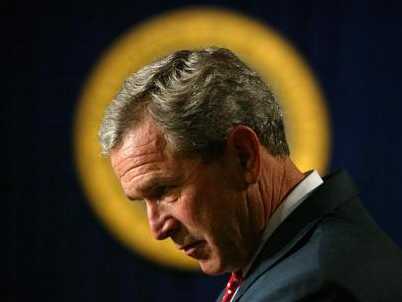
These latter, of course, are the foot-soldiers of the Israel Lobby in America, a group that GOP presidential candidate John McCain has actively courted in the person of the Rev. John Hagee. Rev. Hagee is a vicious Catholic-hater and all-around nut-job who looks forward to a nuclear war in the Middle East as the fulfillment of Biblical prophecy. Hagee has lately taken up with AIPAC, appearing at their last national confab in a starring role.
This administration, which has been in thrall to the Israel lobby more than any other, has been increasing the volume in its war of words with Tehran since January of this year, and, as Bush's reign comes to an inglorious end, there apparently remains one last act of perfidy the neocons will leave as their legacy. Bush's going away gift to the American people looks more than likely to be another war – one that truly does make the Iraq war seem like a "cakewalk" in comparison. It took a few years for the impact of the war in Iraq to be felt by the American people, and its full impact has yet to hit. Not so with the next war. The firing of a few shots at those speedboats sent the price of oil up three bucks. Think of what a full-scale all-out war would do to the price of nearly everything. And for what?
Iran, a signatory to the Nonproliferation Treaty, says it is not seeking to build nuclear weapons, and that the production of nuclear energy for peaceful uses is the one and only goal of its activities on this front. This is more than Israel can say, far more. Everyone knows the Israelis have nukes – the technology for which they probably stole from us – and they are one of the few civilized countries who haven't signed the NPT and refuse to even discuss doing so.
If ever there was a nuclear rogue nation, then surely it is Israel. As Henry Kissinger said of them in a 1969 memo to Richard Nixon: "The Israelis, who are one of the few peoples whose survival is genuinely threatened, are probably more likely than almost any other country to actually use their nuclear weapons." Although the Iranians claim their nuclear program is geared exclusively toward peaceful purposes, that they have the option to act otherwise, should the need arise, is a challenge to Israel's nuclear hegemony. The Iranians, by American and Israeli lights, have no right to a deterrent.
In a world where "benevolent global hegemony" is the goal of U.S. foreign policy, there is no right to self-defense; that, along with national sovereignty, has been abolished. Defiance is met with an implacable campaign for regime-change in the offending nation. By all indications, Iran is the next victim to be made an example of, sometime in mid-summer, or so the rumor goes.
We know where the presidential candidates stand on this issue. Hillary looks forward to the "obliteration" of Iran and takes up Charles Krauthammer's demand that we extend our nuclear shield over Tel Aviv just as we would do the same for, say, Toledo. Indeed, there are not a few who would argue that we would be fully justified in sacrificing the latter in order to save the former, and not all of them are to be found among Rev. Hagee's deluded flock. In any case, we know what the McCain-Hagee position is without even having to ask.
We also know where Obama stands on all or most of this: he advocates a policy of engagement with the Iranians, just as he has endorsed talking with South American caudillo Hugo Chavez, and for the same very sound reasons: because it's talk or fight. He clearly realizes waging perpetual war is hardly in our interests, even if we had the financial and military capacity to carry out such a crazed policy. Yet, if he's speaking out about this, at this crucial moment – when the chairman of the Joint Chiefs is practically declaring war on the Iranians – then I just can't hear him: he must not be speaking very loudly, or perhaps this gets lost amid all the soaring rhetoric about Change and Hope and A Better Tomorrow.
Hillary voted for the Kyl-Lieberman resolution, which designated the Iranian Revolutionary Guards – an official part of the Iranian armed forces – as a "terrorist organization," and now Gen. Petraeus is telling us Tehran is funding, arming, and succoring those who are killing American soldiers and bombing the Green Zone. The main threat against us in Iraq is no longer the Sunni "dead-enders," as Don Rumsfeld liked to call them, it's the Mahdi Army – Iraqi Shi'ites – and the Iranians, who have very close ties to the government our troops are dying to defend. If Bush seeks to obliterate Iranian hopes for regional preeminence by launching an attack before he leaves office, one can hardly see how the Clintons could possibly object: perhaps they'll declare that, this time, we have to send enough troops to "do the job." This, you'll recall, was Hillary's McCain-like critique of the Iraq invasion long before being antiwar was required of all Democratic presidential aspirants. No doubt she'll revert to that when the time comes, but what about Obama?
He could skewer Hillary the hawk with one well-placed arrow, aimed straight at her vulnerability on the Iran issue. With the first shots of a new war already fired, apparently, and rumors of an imminent American strike at Iran flying thick and fast, Obama could denounce her as a warmonger, a McCain in drag, whose short-term political opportunism is helping to embroil us in a quagmire far worse than the one in Iraq, where she played a similar role in 2003. Yet I hear nothing like this coming from Obama's camp. Maureen Dowd nails it, with her typically acerbic take:
"Despite all his incandescent gifts, Obama has missed several opportunities to smash the ball over the net and end the game. Again and again, he has seemed stuck at deuce. He complains about the politics of scoring points, but to win, you've got to score points."
The American people oppose war with Iran, perhaps more than they want out of Iraq: the economic consequences alone will infuriate them far more than any other foreign policy decision of this administration. What the War Party is hoping is that their fury will be directed overseas, at our alleged "enemies" in Tehran, and not at home, in the direction of Washington, where proper blame belongs.
Americans await the advent of a real leader, the sort who could and would focus that anger on the right target. Whether Obama has the gumption – and the strategic sense – to make this fight about policy, not personalities, race, and gender, remains to be seen. He's promised us a new politics, but that doesn't have to mean blandness and an inability to fight. It can and must mean sharp attacks on wrong ideas – and one looks in vain for an idea as wrongheaded as war with Iran. ~ Justin Raimondo
Thomas Paine on Paper Money

Thomas Paine on Paper Money
Daily Article Posted on 4/24/2008 by Thomas Paine
[This essay — a blistering attack on paper money and an embrace of gold and silver as the money of a free society — is part of a larger pamphlet on government written in 1786. It appears in the Complete Writings of Thomas Paine, edited by Philip Foner, Citadel Press, 1945, pp. 405ff. Mises.org is the source of its first-time appearance online.]
I remember a German farmer expressing as much in a few words as the whole subject requires; "money is money, and paper is paper."
All the invention of man cannot make them otherwise. The alchemist may cease his labors, and the hunter after the philosopher's stone go to rest, if paper can be metamorphosed into gold and silver, or made to answer the same purpose in all cases.
Gold and silver are the emissions of nature: paper is the emission of art. The value of gold and silver is ascertained by the quantity which nature has made in the earth. We cannot make that quantity more or less than it is, and therefore the value being dependent upon the quantity, depends not on man. Man has no share in making gold or silver; all that his labors and ingenuity can accomplish is, to collect it from the mine, refine it for use and give it an impression, or stamp it into coin.
Its being stamped into coin adds considerably to its convenience but nothing to its value. It has then no more value than it had before. Its value is not in the impression but in itself. Take away the impression and still the same value remains. Alter it as you will, or expose it to any misfortune that can happen, still the value is not diminished. It has a capacity to resist the accidents that destroy other things. It has, therefore, all the requisite qualities that money can have, and is a fit material to make money of — and nothing which has not all those properties can be fit for the purpose of money.
Paper, considered as a material whereof to make money, has none of the requisite qualities in it. It is too plentiful, and too easily come at. It can be had anywhere, and for a trifle.
There are two ways in which I shall consider paper.
The only proper use for paper, in the room of money, is to write promissory notes and obligations of payment in specie upon. A piece of paper, thus written and signed, is worth the sum it is given for, if the person who gives it is able to pay it, because in this case, the law will oblige him. But if he is worth nothing, the paper note is worth nothing. The value, therefore, of such a note, is not in the note itself, for that is but paper and promise, but in the man who is obliged to redeem it with gold or silver.
Paper, circulating in this manner, and for this purpose, continually points to the place and person where, and of whom, the money is to be had, and at last finds its home; and, as it were, unlocks its master's chest and pays the bearer.
But when an assembly undertakes to issue paper as money, the whole system of safety and certainty is overturned, and property set afloat. Paper notes given and taken between individuals as a promise of payment is one thing, but paper issued by an assembly as money is another thing. It is like putting an apparition in the place of a man; it vanishes with looking at it, and nothing remains but the air.
"When an assembly undertakes to issue paper as money, the whole system of safety and certainty is overturned, and property set afloat."
Money, when considered as the fruit of many years' industry, as the reward of labor, sweat and toil, as the widow's dowry and children's portion, and as the means of procuring the necessaries and alleviating the afflictions of life, and making old age a scene of rest, has something in it sacred that is not to be sported with, or trusted to the airy bubble of paper currency.
By what power or authority an assembly undertakes to make paper money, is difficult to say. It derives none from the Constitution, for that is silent on the subject. It is one of those things which the people have not delegated, and which, were they at any time assembled together, they would not delegate. It is, therefore, an assumption of power which an assembly is not warranted in, and which may, one day or other, be the means of bringing some of them to punishment.
I shall enumerate some of the evils of paper money and conclude with offering means for preventing them.
One of the evils of paper money is that it turns the whole country into stock jobbers. The precariousness of its value and the uncertainty of its fate continually operate, night and day, to produce this destructive effect. Having no real value in itself it depends for support upon accident, caprice, and party; and as it is the interest of some to depreciate and of others to raise its value, there is a continual invention going on that destroys the morals of the country.
It was horrid to see, and hurtful to recollect, how loose the principles of justice were left, by means of the paper emissions during the war. The experience then had should be a warning to any assembly how they venture to open such a dangerous door again.
As to the romantic, if not hypocritical, tale that a virtuous people need no gold and silver, and that paper will do as well, it requires no other contradiction than the experience we have seen. Though some well-meaning people may be inclined to view it in this light, it is certain that the sharper always talks this language.
There are a set of men who go about making purchases upon credit, and buying estates they have not wherewithal to pay for; and having done this, their next step is to fill the newspapers with paragraphs of the scarcity of money and the necessity of a paper emission, then to have a legal tender under the pretense of supporting its credit, and when out, to depreciate it as fast as they can, get a deal of it for a little price, and cheat their creditors; and this is the concise history of paper money schemes.
"The love of gold and silver may produce covetousness, but covetousness, when not connected with dishonesty, is not properly a vice."
But why, since the universal customs of the world has established money as the most convenient medium of traffic and commerce, should paper be set up in preference to gold and silver? The productions of nature are surely as innocent as those of art; and in the case of money, are abundantly, if not infinitely, more so. The love of gold and silver may produce covetousness, but covetousness, when not connected with dishonesty, is not properly a vice. It is frugality run to an extreme. But the evils of paper money have no end. Its uncertain and fluctuating value is continually awakening or creating new schemes of deceit. Every principle of justice is put to the rack, and the bond of society dissolved. The suppression, therefore, of paper money might very properly have been put into the act for preventing vice and immorality.
The pretense for paper money has been that there was not a sufficiency of gold and silver. This, so far from being a reason for paper emissions, is a reason against them.
As gold and silver are not the productions of North America, they are, therefore, articles of importation; and if we set up a paper manufactory of money, it amounts, as far as it is able, to prevent the importation of hard money, or to send it out again as fast it comes in; and by following this practice we shall continually banish the specie, till we have none left, and be continuously complaining of the grievance instead of remedying the cause.
Considering gold and silver as articles of importation, there will in time, unless we prevent it by paper emissions, be as much in the country as the occasions of it require, for the same reasons there are as much of other imported articles. But as every yard of cloth manufactured in the country occasions a yard the less to be imported, so it is by money, with this difference, that in the one case we manufacture the thing itself and in the other we do not. We have cloth for cloth, but we have only paper dollars for silver ones.
As to the assumed authority of any assembly in making paper money, or paper of any kind, a legal tender, or in other language, a compulsive payment, it is a most presumptuous attempt at arbitrary power. There can be no such power in a republican government: the people have no freedom — and property no security — where this practice can be acted: and the committee who shall bring in a report for this purpose, or the member who moves for it, and he who seconds it merits impeachment, and sooner or later may expect it.
Of all the various sorts of base coin, paper money is the basest. It has the least intrinsic value of anything that can be put in the place of gold and silver. A hobnail or a piece of wampum far exceeds it. And there would be more propriety in making those articles a legal tender than to make paper so.
It was the issuing base coin, and establishing it as a tender, that was one of the principal means of finally overthrowing the power of the Stuart family in Ireland. The article is worth reciting as it bears such a resemblance to the process practiced in paper money.
Brass and copper of the basest kind, old cannon; broken bells, household utensils were assiduously collected; and from every pound weight of such vile materials, valued at four pence, pieces were coined and circulated to the amount of five pounds normal value. By the first proclamation they were made current in all payments to and from the King and the subjects of the realm, except in duties on the importation of foreign goods, money left in trust, or due by mortgage, bills or bonds; and James promised that when the money should be decried, he would receive it in all payments, or make full satisfaction in gold and silver. The nominal value was afterwards raised by subsequent proclamations, the original restrictions removed, and this base money was ordered to be received in all kinds of payments As brass and copper grew scarce, it was made of still viler materials, of tin and pewter, and old debts of one thousand pounds were discharged by pieces of vile metal amounting to thirty shillings in intrinsic value. (Leland's History of Ireland, vol. iv. p. 265.)
Had King James thought of paper, he needed not to have been at the trouble or expense of collecting brass and copper, broken bells, and household utensils.
The laws of a country ought to be the standard of equity, and calculated to impress on the minds of the people the moral as well as the legal obligations of reciprocal justice. But tender laws, of any kind, operate to destroy morality, and to dissolve, by the pretense of law, what ought to be the principle of law to support, reciprocal justice between man and man — and the punishment of a member who should move for such a law ought to be death.
When the recommendation of Congress, in the year 1780, for repealing the tender laws was before the Assembly of Pennsylvania, on casting up the votes, for and against bringing in a bill to repeal those laws, the numbers were equal, and the casting vote rested on the speaker, Colonel Bayard.
"I give my vote," said he, "for the repeal, from a consciousness of justice; the tender laws operate to establish iniquity by law." But when the bill was brought in, the House rejected it, and the tender laws continued to be the means of fraud.
If anything had or could have a value equal to gold and silver, it would require no tender law; and if it had not that value it ought not to have such a law; and, therefore, all tender laws are tyrannical and unjust and calculated to support fraud and oppression.
Most of the advocates for tender laws are those who have debts to discharge, and who take refuge in such a law, to violate their contracts and cheat their creditors. But as no law can warrant the doing an unlawful act, therefore the proper mode of proceeding, should any such laws be enacted in future, will be to impeach and execute the members who moved for and seconded such a bill; and put the debtor and the creditor in the same situation they were in, with respect to each other, before such a law was passed.
Men ought to be made to tremble at the idea of such a bare-faced act of injustice. It is in vain to talk of restoring credit, or complain that money cannot be borrowed at legal interest; until every idea of tender laws is totally and publicly reprobated and extirpated from among us.
"Most of the advocates for tender laws are those who have debts to discharge, and who take refuge in such a law, to violate their contracts and cheat their creditors."
As to paper money, in any light it can be viewed, it is at best a bubble. Considered as property, it is inconsistent to suppose that the breath of an assembly, whose authority expires with the year, can give to paper the value and duration of gold. They cannot even engage that the next assembly shall receive it in taxes. And by the precedent (for authority there is none), that one assembly makes paper money, another may do the same, until confidence and credit are totally expelled, and all the evils of depreciation acted over again. The amount, therefore, of paper money is this, that it is the illegitimate offspring of assemblies, and when their year expires, they leave a vagrant on the hands of the public….
Paper money is like dram-drinking, it relieves for a moment by deceitful sensation, but gradually diminishes the natural heat, and leaves the body worse than it found it. Were not this the case, and could money be made of paper at pleasure, every sovereign in Europe would be as rich as he pleased. But the truth is, that it is a bubble and the attempt vanity. Nature has provided the proper materials for money: gold and silver, and any attempt of ours to rival her is ridiculous….
Paper money appears at first sight to be a great saving, or rather that it costs nothing; but it is the dearest money there is. The ease with which it is emitted by an assembly at first serves as a trap to catch people in at last. It operates as an anticipation of the next year's taxes. If the money depreciates, after it is out, it then, as I have already remarked, has the effect of fluctuating stock, and the people become stock-jobbers to throw the loss on each other.
If it does not depreciate, it is then to be sunk by taxes at the price of hard money; because the same quantity of produce, or goods, that would procure a paper dollar to pay taxes with, would procure a silver one for the same purpose. Therefore, in any case of paper money, it is dearer to the country than hard money, by all the expense which the paper, printing, signing, and other attendant charges come to, and at last goes into the fire.
Suppose one hundred thousand dollars in paper money to be emitted every year by the assembly, and the same sum to be sunk every year by taxes, there will then be no more than one hundred thousand dollars out at any one time. If the expense of paper and printing, and of persons to attend the press while the sheets are striking off, signers, etc. be five percent., it is evident that in the course of twenty years' emissions, the one hundred thousand dollars will cost the country two hundred thousand dollars. Because the paper maker's and printer's bills, and the expense of supervisors and signers, and other attendant charges will in that time amount to as much as the money amounts to; for the successive emissions are but a recoinage of the same sum.
But gold and silver require to be coined but once, and will last a hundred years (better than paper will one year) and at the end of that time be still gold and silver. Therefore, the saving to government, in combining its aid and security with that of the bank in procuring hard money, will be an advantage to both, and to the whole community.
The case to be provided against, after this, will be that the government do not borrow too much of the bank, nor the bank lend more notes than it can redeem; and, therefore, should anything of this kind be undertaken, the best way will be to begin with a moderate sum, and observe the effect of it. The interest given the bank operates as a bounty on the importation of hard money, and which may not be more than the money expended in making paper emissions.
Thomas Paine (1737–1809) was an English pamphleteer, revolutionary, radical, and classical liberal. Born in the market town of Thetford, England, he migrated to the American colonies at the age of 37, just in time to take part in the American Revolution. His main contribution was as the author of the powerful, widely read pamphlet, "Common Sense" (1776), advocating independence for the American colonies from Great Britain. He is also known for "The American Crisis" (1776–1783), a series of pamphlets supporting the American Revolution, and "The Rights of Man" (1791) defending the early French Revolution. Comment on the blog.
This essay is part of a larger pamphlet on government written in 1786. It appears in the Complete Writings of Thomas Paine, edited by Philip Foner, Citadel Press, 1945, pp. 405ff.
We'll make you see death

April 10, 2008 On a recent trip to Amman, Jordan, during a visit to the home of someone who had been detained by the Jordanian intelligence service in 2002, I was given two very thin strips of paper covered with Arabic writing and marked with a thumbprint. Curled up into a tight spiral, they were no bigger than the cap of a pen.
My contact, who had smuggled the papers out of intelligence detention a few years previously, told me that the message therein had been written by a prisoner who had been detained with him. He said it gave a detailed account of that person's experiences.
That evening, in my hotel room, an Egyptian colleague translated the text, word for word. Stunned by its contents, I transcribed the message into electronic form and sent it into cyberspace for safekeeping.
The message's author was a Yemeni terrorism suspect named Ali al-Hajj al-Sharqawi, who was arrested in Pakistan in February 2002. Though the message was undated, it was clear from the narrative that it had been written in October 2002.
Sharqawi said that he had been delivered to Jordan by the CIA. Unknown to the outside world, he was held as a secret prisoner by the Jordanian intelligence service: unregistered, cut off from all communication and hidden during visits by representatives of the International Committee of the Red Cross.
_qoptions = { tags:"ADSDAQ.LAWPOLITICS,504413" }; _qacct="p-01-0VIaSjnOLg";setTimeout("quantserve()",3000);
In the note, which he managed to slip to my contact without his captors noticing, he gave what he called a "short summary of my sufferings."
"They beat me up in a way that does not know mercy," Sharqawi wrote, referring to his Jordanian captors, "and they're still beating me. They threatened me with electricity, with snakes and dogs ... [They said] we'll make you see death."
Sharqawi described his interrogations, explaining that the Jordanians were feeding his responses back to the CIA. "Every time that the interrogator asks me about a certain piece of information, and I talk," Sharqawi said, "he asks me if I told this to the Americans. And if I say no he jumps for joy, and he leaves me and goes to report it to his superiors, and they rejoice."
I didn't dare leave Sharqawi's note in my hotel room, so I carried it in my purse for the two weeks that I remained in Jordan. During that time, I interviewed several Jordanians who had been held with Sharqawi and other prisoners who had been handed over to Jordan by the CIA. Former detainees spoke of a period, in 2002-2003, when the third floor of the intelligence service's detention facility was "full" of foreign prisoners who had been delivered by the CIA. Although the prisoners had been held in solitary confinement, they had managed to communicate by knocking on cell walls and speaking surreptitiously through cell windows.
How did it come to pass that these men -- non-Jordanians all -- had been brought to Jordan? The practice of extraordinary rendition, or turning over terrorist suspects abroad, goes back to the Clinton administration, when the CIA transferred several Egyptian terrorist suspects from countries such as Albania and Croatia to Egypt. After Sept. 11, 2001, however, the CIA's rendition practices changed. Rather than returning people to their home countries to face "justice" (albeit justice that included physical abuse and grossly unfair trials), the CIA began handing people over to third-party countries to be detained and interrogated -- countries known to use torture.
Jordan is not the only country to which the CIA has sent prisoners for proxy detention. Egypt has held several such prisoners, and Morocco is believed to have held some. Yet the Jordanian intelligence service has long had an exceptionally close and cooperative relationship with the CIA, so the CIA relied heavily on Jordan for holding prisoners outside of the protection of the laws.
Largely through my interviews in Jordan -- piecing together accounts by former and current prisoners -- I was able to identify 13 other non-Jordanians who, like Sharqawi, were apparently rendered to Jordan from American custody in the years that followed the Sept. 11 attacks. In all likelihood, the actual number of rendered suspects was higher, given the secrecy of the detentions and the enormous difficulties that detainees faced in communicating. None of the detainees whom I learned of had been held after 2004 -- though, again, the secrecy means that a full and comprehensive picture of the detainees and timeline will take time to emerge. There could be many more about whom we do not already know.
_qoptions = { tags:"ADSDAQ.LAWPOLITICS,504413" }; _qacct="p-01-0VIaSjnOLg";setTimeout("quantserve()",3000);
Responsibility for the renditions is truly international. While the United States and Jordan are most directly implicated, the countries in which the detainees were originally found are also complicit. Most of the rendered suspects were arrested in either of two places: Pakistan, particularly the city of Karachi; and Georgia, particularly from the Pankisi Gorge. One detainee reportedly said that he was held for three months at a U.S. prison in Iraq before being moved to Jordan, while many others later were held in secret CIA detention in Kabul or at the U.S. military base at Bagram, in Afghanistan.
A pressing question is where these men ultimately ended up. Since the rendered prisoners were not Jordanian, Jordan was a place of temporary detention and interrogation, not a permanent jailer. Even before my trip to Jordan, we knew that some of them -- including Sharqawi -- were now being held at Guantánamo Bay, Cuba. Sharqawi has been held there since late 2004 without ever being charged with any crime. A couple of others are believed to be in detention elsewhere, and at least one is free, but the whereabouts of other prisoners are unknown. It is possible that many or all of the remaining detainees -- which include citizens of Algeria, Tunisia and Syria -- underwent a second rendition, being transferred from Jordan back to their home countries without legal proceedings or any opportunity to challenge such a transfer. The treatment they may be enduring is unknown.
The Jordanian government continues to deny that it ever held rendered detainees. Not long after I received Sharqawi's note, I met with a group of senior Jordanian intelligence officials and put our information to them. My two colleagues and I were sitting on one side of a long conference table; our Jordanian interlocutors were on the other side. It felt like a debate. I did not confront them with the note, for fear that it would be confiscated, but I did mention Sharqawi as an example of someone who had been transferred by the CIA to Jordan. They frowned -- and categorically rejected the idea. Not only had Jordan never detained terrorism suspects delivered by the CIA, they asserted, but they had "disproved" such allegations in the past.
But the note from Sharqawi that I received is more than an allegation; it is tangible and compelling evidence. And the multiple, independent accounts I heard from former detainees are more than just allegations, too -- they form a pattern of consistent testimony. Add to this the flight logs of CIA flights to Jordan, which correspond with the dates of detainee transfers, and a clear picture starts to emerge.
The Jordanians can continue to deny their involvement, and the CIA can refuse to comment, but the fact of CIA renditions to Jordan has been documented. We know that they happened. The key objectives, at this point, are to achieve some measure of accountability for these abuses and to make sure that they don't happen again.
Subscribe to:
Posts (Atom)